
The integration backend
for AI agents
Agents describe what they need. Fyrn generates, deploys, and heals integrations via MCP. No HTTP boilerplate. No broken pipelines.
{
  "method": "tools/call",
  "params": {
    "name": "create_flow",
    "arguments": {
      "description": "When a Stripe payment succeeds, create an invoice in NetSuite and notify #billing in Slack",
      "connectors": ["stripe", "netsuite", "slack"],
      "deploy": true
    }
  }
}name: stripe-to-netsuite-billing
trigger:
connector: stripe
event: payment_intent.succeeded
steps:
- transform:
map:
amount: "{{ trigger.amount / 100 }}"
customer: "{{ trigger.customer }}"
currency: "{{ trigger.currency }}"
- deliver:
connector: netsuite
action: invoice.create
- notify:
connector: slack
channel: "#billing"Agents are powerful. Their API access isn't.
Raw HTTP is fragile
Agents cobble together API calls with hardcoded URLs, auth headers, and payload shapes. One schema change and the whole chain breaks silently.
APIs change constantly
Stripe, Salesforce, HubSpot — they all ship breaking changes. Agents can't detect drift. They just start failing at 3 AM.
No observability
When agents make raw API calls, there's no audit trail, no retry logic, no circuit breakers. You're debugging in the dark.
Four steps. Zero boilerplate.
Agent calls MCP tool
Your agent calls create_flow with a natural language description. No API docs needed.
Fyrn generates config
AI compiles the description into a deterministic YAML config — connectors, mappings, error handling, all included.
Deterministic execution
The config deploys to a predictable runtime. Retries, circuit breakers, rate limiting. No AI in the hot path.
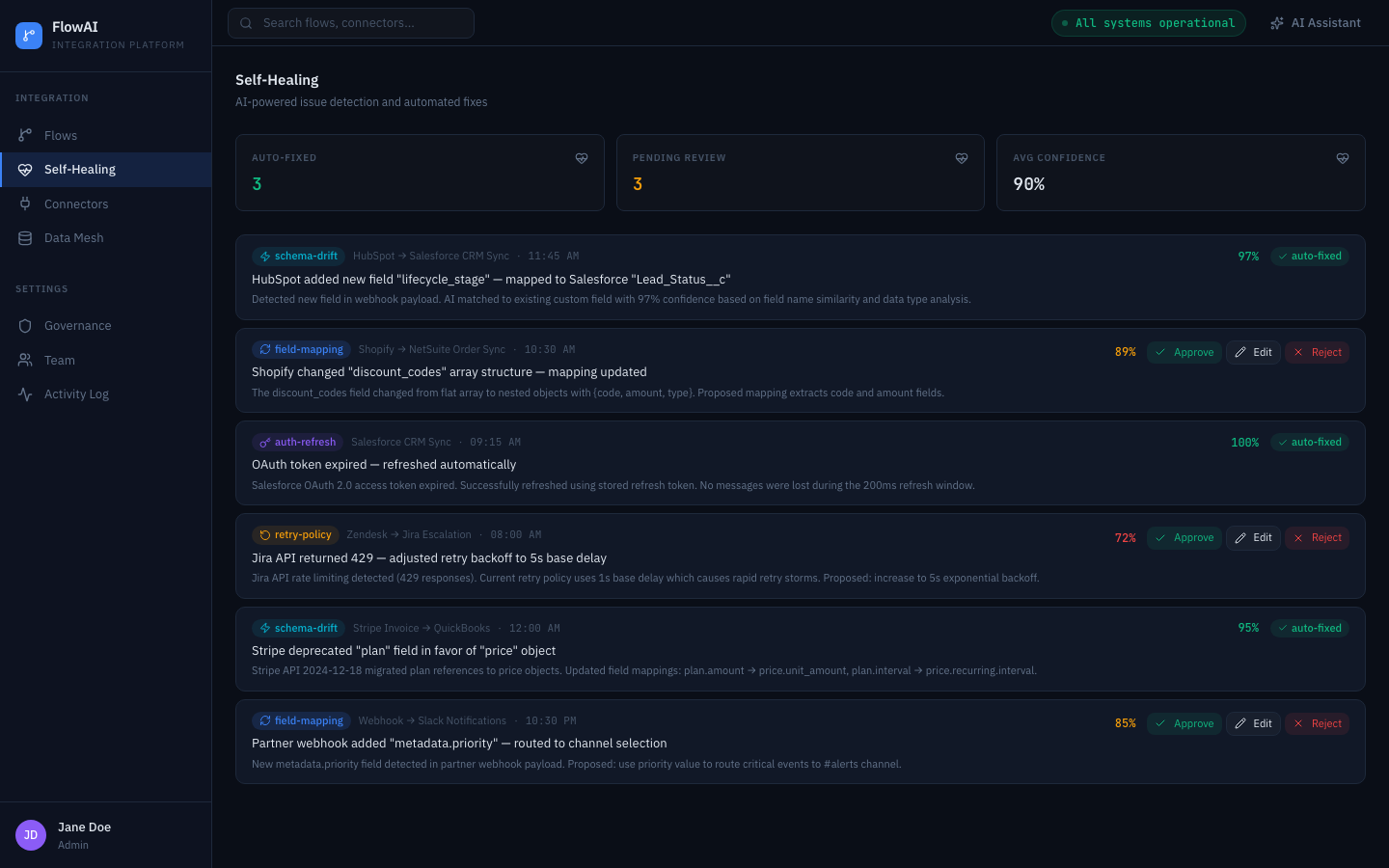
Self-healing repairs drift
APIs change. Fyrn detects schema drift, auto-fixes mappings, and keeps your agent's integrations running.
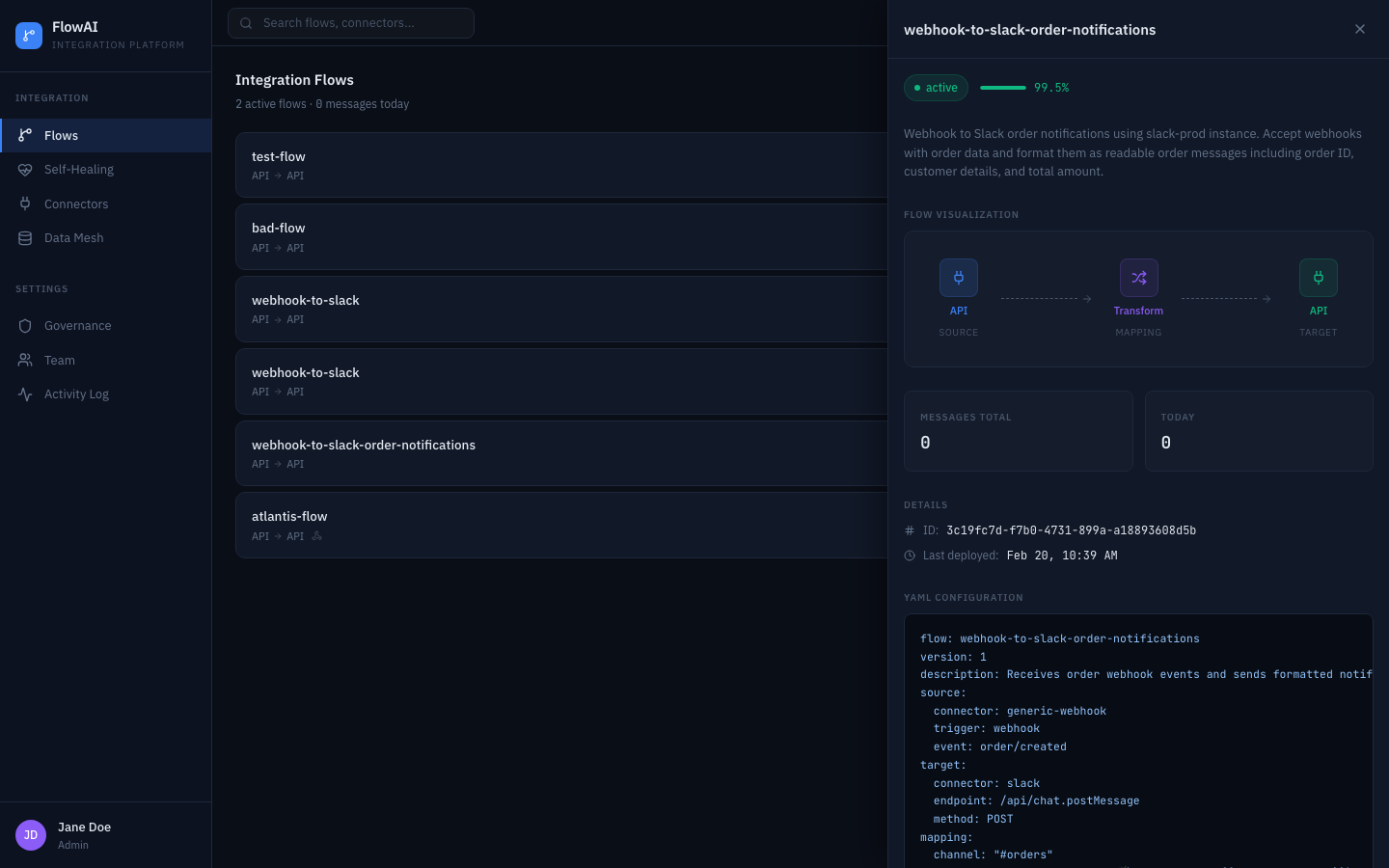
Every flow your agent creates is observable
Flows created via MCP show up in the same dashboard as everything else — health metrics, YAML config, flow visualization, and execution logs.
Full MCP server. Three permission tiers.
Every tool your agent needs to build, deploy, and manage integrations — scoped by permission tier.
Read-only access. List and inspect flows, query status, browse connectors, view message logs, and call published APIs.
list_flows get_flow get_flow_status get_logs call_published_api +more Create and deploy. Generate flows from natural language, create custom adapters, publish APIs, deploy to production, and run batch jobs.
create_flow AI deploy_flow create_adapter AI create_published_api AI start_batch +more Full operations. Edit live flows, pause and resume, retry failed messages, update schedules, approve self-healing fixes, and manage team settings.
edit_flow approve_healing retry_message pause_flow update_schedule +more {
"name": "create_flow",
"description": "Create and optionally deploy an integration flow from a natural language description",
"inputSchema": {
"type": "object",
"properties": {
"description": {
"type": "string",
"description": "Natural language description of the integration"
},
"connectors": {
"type": "array",
"items": { "type": "string" }
},
"deploy": {
"type": "boolean",
"default": false
}
},
"required": ["description"]
}
}Enterprise-grade agent governance
Agents get powerful tools. You keep full control. Every action is permissioned, rate-limited, and audited.
Approval gates
16 mutating tools require human approval before execution. Agents propose changes, humans confirm.
Tiered permissions
Readonly, Operator, and Admin tiers with per-agent tool whitelisting. Grant exactly the access each agent needs.
Loop detection
Blocks agents calling the same tool with identical inputs 5+ times in 60 seconds. Prevents runaway automation.
PII filtering
Auto-masks emails, phone numbers, SSNs, and sensitive fields in tool responses. Agents only see what they're granted.
Rate limiting
Per-minute and daily quota enforcement per agent key. Prevent cost overruns and abuse automatically.
Audit logging
Structured JSON logs for every tool call — status, duration, agent identity, and full request/response chain.
Works with every agent platform
MCP is an open standard. Adopted by Anthropic, OpenAI, and the broader agent ecosystem. Any agent that speaks MCP can use Fyrn as its integration backend — no vendor lock-in.
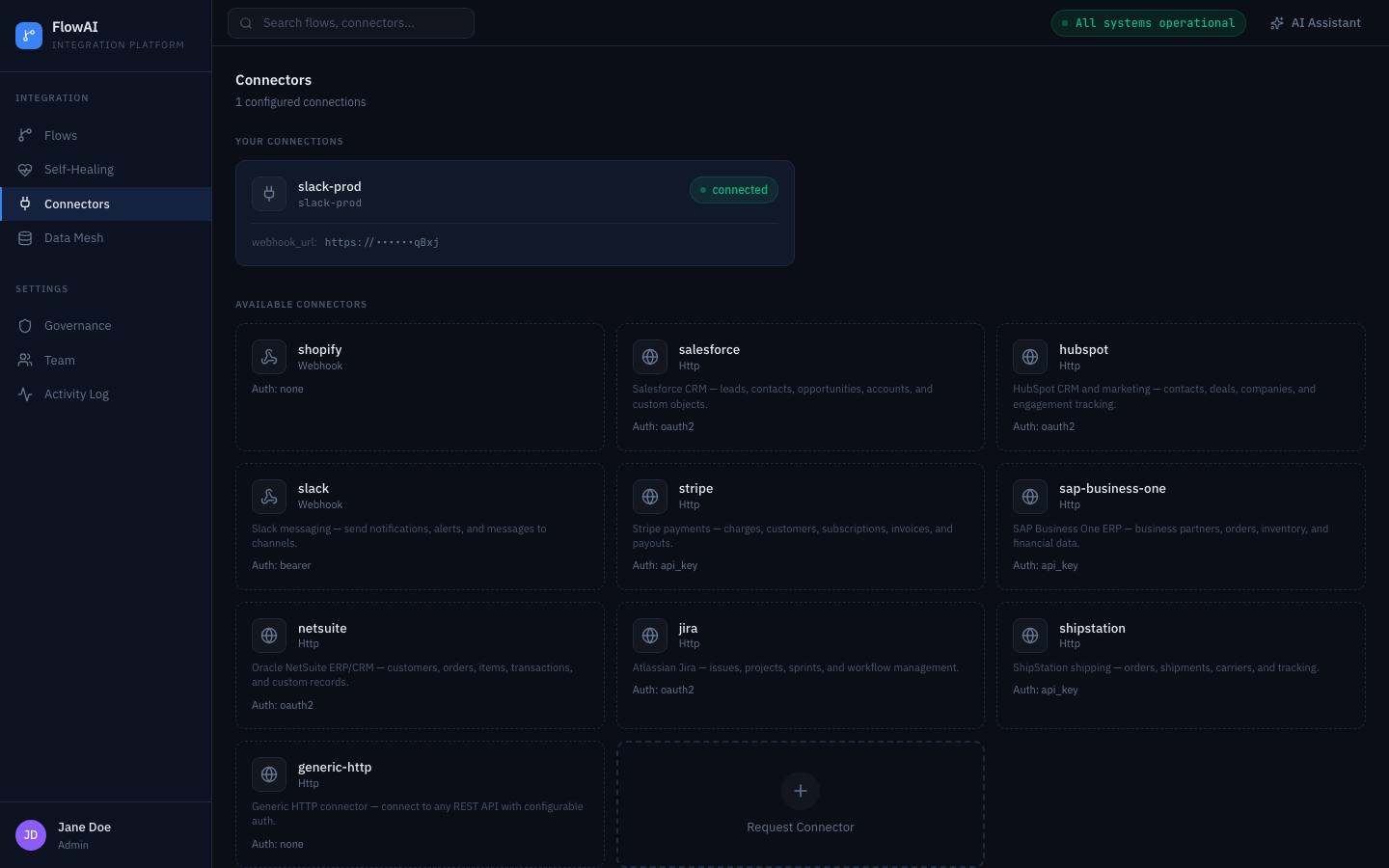
Unattended agents need unbreakable integrations
Agents run 24/7 without human supervision. When a third-party API ships a breaking change at 2 AM, Fyrn detects the drift, updates the mapping, and keeps your agent's workflows running — no pages, no firefighting.
Agent configures Stripe → Salesforce
An agent describes the integration, Fyrn creates the flow, and deploys it to production — in one conversation.
# Agent configures a Stripe → Salesforce sync

Agent: I need to sync new Stripe customers to Salesforce as contacts, with their subscription plan mapped to a custom field.

Fyrn MCP: Creating flow...
✓ Generated stripe-to-salesforce-contacts.yaml
✓ Validated 2 connectors, 0 errors

Agent: Deploy it to production.

Fyrn MCP: Deploying...
✓ Deployed to production
✓ Health check passed — flow activename: stripe-to-salesforce-contacts
trigger:
connector: stripe
event: customer.created
steps:
- transform:
map:
first_name: "{{ trigger.name | split(' ') | first }}"
last_name: "{{ trigger.name | split(' ') | last }}"
email: "{{ trigger.email }}"
subscription_plan: "{{ trigger.subscriptions.data[0].plan.id }}"
- deliver:
connector: salesforce
action: contact.create
custom_fields:
Stripe_Plan__c: "{{ steps[0].subscription_plan }}"Connect your agents to everything
Give your agents a production-grade integration backend. MCP-native. Self-healing. Deploy in minutes.